
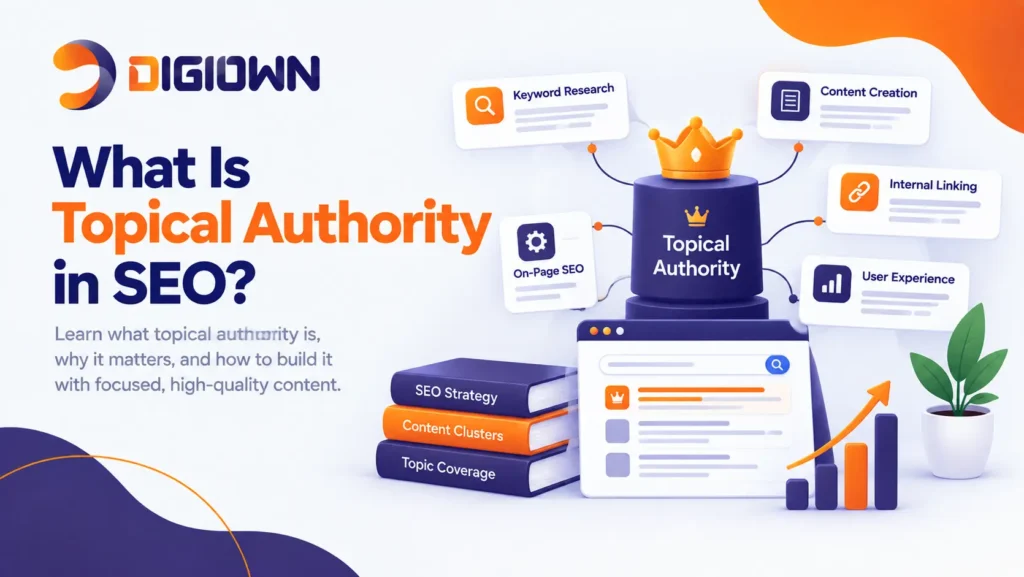

Topical authority in SEO is the level of expertise, relevance, and trust that search engines associate with a website for a specific subject. A website develops topical authority when content covers a subject comprehensively, answers related search intents, demonstrates expertise, and connects relevant pages through clear internal linking.
Topical authority does not mean publishing one article for every keyword. Search engines evaluate relationships among concepts, entities, questions, pages, links, and user needs. A strong topical strategy focuses on complete subject coverage rather than keyword volume alone. For DIGIOWN, this means building content that supports important SEO services, answers customer questions, and establishes expertise around commercially relevant topics.
What Does Topical Authority Mean in SEO?
Topical authority means search engines can recognize your website as a reliable source for a defined subject because your site consistently provides relevant, useful, and connected information about that subject.
A topical authority strategy combines four elements: comprehensive content coverage, strong E-E-A-T signals, logical internal links, and relevant external references. The objective is useful, credible coverage within your legitimate area of expertise.
For example, an SEO agency that wants authority around technical SEO could publish a pillar page about technical SEO, then create detailed pages about crawling, indexing, canonical tags, robots.txt, XML sitemaps, JavaScript SEO, Core Web Vitals, structured data, migrations, and technical audits. Each page addresses a distinct intent while contributing to one coherent subject area.
Topical Authority vs Domain Authority
Topical authority measures subject-specific expertise, while Domain Authority is a third-party metric that estimates the overall backlink strength of a website.
Domain Authority does not represent an official Google ranking score. Similar third-party metrics include Domain Rating (DR) and other authority scores. These metrics primarily evaluate link-related signals. Topical authority focuses on how comprehensively and credibly a site covers a particular subject.
A website can have strong backlink strength but weak topical relevance for a niche. A smaller specialist website can compete when it provides deeper, more relevant coverage. Strong SEO programs usually need both topical relevance and authoritative links.
Why Does Topical Authority Matter?
Topical authority matters because comprehensive subject coverage helps search engines understand what your website specializes in and which queries your pages can satisfy.
A strong topical structure can produce benefits:
- Broader organic visibility across related queries
- Better alignment between content and search intent
- Stronger internal connections between commercial and informational pages
- More opportunities to earn relevant backlinks and brand mentions
- Greater visibility across AI Overviews and other AI search experiences
- More qualified organic traffic from users with specific needs
Topical authority can support rankings, but topical authority is not a standalone Google metric that guarantees a position. Search performance also depends on relevance, content quality, links, technical accessibility, competition, and user intent.
How Does Topical Authority Affect Search Rankings?
Topical authority affects search performance by helping search engines establish stronger relationships between your website, its content, and a subject.
Google uses systems designed to understand meaning, context, language, entities, and relationships. Hummingbird, RankBrain, and BERT strengthened Google’s ability to interpret queries beyond exact keyword matching. A well-organized topical site gives search engines stronger contextual evidence about covered subjects.
A website with only an “SEO services” page provides limited evidence about its knowledge of SEO. A website that explains technical SEO, local SEO, keyword research, content strategy, internal linking, audits, migrations, and measurement provides broader context.
Topical authority does not replace backlinks or technical SEO. Topical relevance works alongside crawlability, indexing, page quality, link signals, and search intent.
How to Build Topical Authority
To build topical authority, define a focused subject, map its important subtopics, create useful content for each relevant intent, connect related pages, demonstrate first-hand expertise, earn relevant external references, and maintain the cluster over time.
1. Choose a Focused Core Topic
Start with a subject that directly supports your business, audience, products, or services. A focused topic makes content planning more precise and helps your website establish a consistent subject identity.
A seed keyword provides the starting point for topic-based keyword research. Choose a seed term that is broad enough to contain meaningful subtopics but narrow enough to remain commercially relevant.
For example, an accounting firm could choose “small business accounting” rather than “business.” An SEO agency could choose “technical SEO” rather than “marketing.”
Define your topical boundary before producing content. Ask whether each proposed subject is genuinely relevant to your customers and whether your business has a credible reason to discuss the subject.
2. Perform Topic-Based Keyword Research
Topic-based keyword research identifies the questions, subtopics, entities, comparisons, processes, and problems connected to your core subject.
Start with a seed keyword and expand the research through keyword databases, competitor analysis, search suggestions, People Also Ask results, forums, customer questions, sales conversations, and existing website data.
Separate keywords by intent instead of assigning one page to every phrase. Several keywords can share one intent and belong on one comprehensive page. Separate pages for minor keyword variations can create duplication and unnecessary maintenance.
Group terms into categories such as:
- Definitions and foundational questions
- How-to and implementation queries
- Comparisons and alternatives
- Problems and troubleshooting
- Commercial investigation
- Product or service requirements
- Industry-specific applications
A topic map should reflect the information journey your audience follows before, during, and after a purchase.
3. Find Competitive Topic Gaps
Content gap analysis shows where competitors provide useful coverage that your website lacks.
Review competing websites that rank consistently for your target subject. Examine their service pages, guides, FAQs, category pages, supporting articles, and internal links. Tools such as Ahrefs Keywords Explorer and its Competitive Analysis features can accelerate this process.
A competitor sitemap can reveal pages hidden from navigation. Competitor analysis should not mean copying content. Use competitor coverage to identify missing questions, weak explanations, underserved intents, and opportunities for original research.
Prioritize gaps by business relevance, search demand, audience value, and your ability to provide credible expertise.
4. Build Pillar Pages and Topic Clusters
A pillar page provides broad coverage of a major subject, while cluster content answers narrower questions within that subject.
A “technical SEO” cluster could contain a pillar page plus resources about crawling, indexing, canonicalization, structured data, JavaScript rendering, XML sitemaps, and technical audits. Internal links should connect the pillar page with relevant cluster pages and connect closely related cluster pages where useful.
Do not create a separate page simply because a tool displays another keyword. Combine closely related terms when intent is substantially the same. Create separate pages when a query requires a distinct answer, format, audience need, or detail level.
The result should be a useful content hub that search engines can interpret.
5. Match Every Page to Search Intent
Search intent determines what a searcher expects from a query.
A definition query needs a concise explanation followed by relevant detail. A “how to” query needs actionable steps. A commercial query needs information about options, features, suitability, costs, or services. A comparison needs clear differences and decision criteria.
Review current search results before finalizing a page. SERP analysis reveals dominant formats, depth, subtopics, and user expectations.
Search intent should control page scope. Do not add unrelated sections simply to increase word count. Comprehensive content means complete coverage of the intended problem, not maximum length.
6. Demonstrate E-E-A-T
E-E-A-T stands for Experience, Expertise, Authoritativeness, and Trustworthiness. Strong topical authority requires evidence that your content is produced by people with appropriate knowledge and experience. For agency websites, information about the team and our expertise can also help readers understand the experience behind the content.
Add meaningful author information, explain methods where relevant, cite primary sources, use original data, provide first-hand observations, and disclose important limitations. For sensitive subjects, make qualifications and review processes clear.
Experience matters when practical knowledge changes usefulness. A case study, original test, documented process, expert interview, or real implementation can provide evidence that a generic summary cannot.
E-E-A-T is not a single score that websites can optimize. E-E-A-T represents qualities Google’s quality guidance asks evaluators to consider when assessing content.
7. Strengthen Internal Linking
Internal links connect related pages and help users discover supporting information.
Build links from pillar pages to relevant cluster content. Link cluster pages back to the appropriate pillar where useful. Add contextual cross-links between closely related articles when a link helps the reader understand the subject.
Use descriptive anchor text that accurately identifies the destination. Avoid forcing exact-match keywords into every anchor.
Audit your website for orphan pages, weakly connected resources, excessive links to unrelated topics, and important pages that receive little internal support. A strong internal linking structure makes topical relationships clearer and creates a logical path between informational content and commercial pages.
8. Earn Topically Relevant Backlinks
Backlinks remain important, but relevance matters when you want to reinforce subject authority.
Seek references from websites, publications, organizations, and professionals in your industry or related fields. Useful methods include digital PR, original research, expert commentary, resource development, and industry contributions.
A backlink from a relevant publication can reinforce the association between your brand and a subject. Unrelated backlinks do not automatically establish topical expertise.
Brand mentions can support broader visibility without a hyperlink. Monitor relevant discussions and contribute useful information rather than pursuing artificial mentions.
9. Create Original, Problem-Solving Content
Authoritative content solves real problems better than competing resources.
Use customer questions, support tickets, sales objections, expert interviews, original research, case studies, product data, and first-hand experience to identify useful content opportunities. Add information that competitors cannot easily reproduce.
A strong article should answer the main question quickly, then provide evidence, examples, processes, limitations, and next steps. Commercial pages can connect with supporting resources, while informational articles can guide qualified readers toward relevant services.
Avoid publishing large volumes of thin, repetitive, or automatically generated pages. Content quantity does not equal topical authority.
10. Keep Topic Clusters Complete and Current
Topical authority requires ongoing maintenance because subjects, products, regulations, technologies, and user questions change.
Review important clusters periodically. Update outdated statistics, screenshots, examples, references, and recommendations. Consolidate pages when multiple URLs compete for the same intent, redirect obsolete pages when appropriate, and repair broken internal links.
Run content gap analysis at regular intervals to identify new questions and competitor coverage. New technologies and changing search behavior can create new subtopics that belong within an existing cluster.
How Google Measures Topical Authority
Google has not published a formal topical authority score that website owners can inspect for ordinary web search.
Google evaluates relevance and quality through numerous ranking systems, and Google’s public documentation emphasizes helpful, reliable, people-first content. Search systems use language understanding, content relevance, links, site structure, user intent, and other signals to determine which results best satisfy a query.
The 2024 Google API leak generated discussion about internal concepts related to site focus and topical concentration. The leak should not be treated as an official public ranking guide, and undocumented internal fields should not be presented as confirmed ranking formulas.
The reliable SEO principle is simple: maintain topical focus, publish useful expert content, connect related resources, and avoid content unrelated to your core subject.
Topical Authority and AI Search
Topical authority has become increasingly relevant to AI search because AI-generated answers require sources that systems can identify as relevant and credible.
AI Overviews and AI search platforms can synthesize information from multiple sources. Comprehensive topic coverage can increase the number of relevant pages that a system can associate with your brand and subject.
AI visibility does not depend on a fixed article count, and AI search optimization can help businesses structure content for emerging search experiences. AI systems can evaluate content quality, relevance, entity relationships, brand references, and source credibility. Strong topical coverage therefore supports visibility across traditional and AI search.
How to Measure Topical Authority
Topical authority requires several measurements because no metric captures the concept.
Track keyword coverage across your target topic clusters. Monitor rankings for core terms, long-tail queries, and related entities. Measure organic traffic to cluster pages and examine whether pages earn visibility for relevant queries that were not explicitly targeted.
Use Google Search Console to review queries, impressions, clicks, and ranking changes. Use analytics data to evaluate organic acquisition and conversions. Ahrefs can help evaluate keyword coverage, competing pages, referring domains, and content gaps.
Track branded searches that combine your brand with your core subject. An expanding variety of topic-specific branded queries can indicate stronger association between your brand and that subject.
Track AI visibility separately where reliable monitoring exists. Check whether your brand appears for relevant prompts, which pages receive citations, and which topic areas remain weak.
Common Topical Authority Mistakes
The most common mistake is treating topical authority as a page-count exercise. Publishing one article for every keyword can create overlapping URLs without improving coverage.
Other mistakes include:
- Publishing content outside the business’s credible topical focus
- Creating thin articles that repeat existing information
- Ignoring search intent
- Using internal links without a logical relationship
- Chasing unrelated backlinks
- Copying competitor topics without adding original value
- Leaving outdated content untouched
- Creating separate pages for near-identical keyword variants
- Measuring success only through one head keyword
A strong topical strategy prioritizes relevance, depth, evidence, and page relationships.
How Many Articles Do You Need for Topical Authority?
There is no fixed number of articles required to establish topical authority. A narrow niche may require fewer comprehensive resources, while a broad commercial subject may require dozens or hundreds of connected pages.
Use coverage quality rather than an arbitrary publishing target. A content plan is sufficiently developed when important subtopics, search intents, customer questions, and commercial needs receive useful coverage without duplication.
Topical Authority for Local and Service Businesses
Local and service businesses can build topical authority by connecting expertise with location and customer needs.
A dental practice, for example, can support a dental service page with focused resources about procedures, preparation, recovery, risks, costs, candidacy, aftercare, and common questions. Relevant location pages can support local intent when each location page provides genuine local value.
Service businesses should avoid unrelated articles merely because those articles have search volume. Every supporting topic should strengthen expertise and help potential customers make informed decisions.
Final Takeaway
Topical authority in SEO comes from consistent, credible, and connected coverage of a subject that matters to your audience and business. The strongest strategy combines topic-based keyword research, focused clusters, search-intent alignment, E-E-A-T evidence, internal linking, relevant backlinks, original insights, and continuous content maintenance.
Do not measure topical authority by article count alone. Build a clear topical map, cover meaningful subtopics, connect resources logically, and provide information that demonstrates genuine expertise. That approach gives search engines stronger context and gives users better answers across traditional search and AI-driven discovery.
Frequently Asked Questions
What is topical authority in SEO with an example?
Topical authority in SEO is the recognition a website earns as a reliable expert on a specific subject. For example, an SEO agency covering technical SEO, audits, crawling, indexing, structured data, migrations, and Core Web Vitals can establish strong authority around technical SEO.
How do you build topical authority for a website?
You build topical authority by selecting a focused subject, researching related search intents, creating pillar and cluster content, demonstrating E-E-A-T, strengthening internal links, earning relevant backlinks, publishing original insights, and updating content as the topic and audience needs change.
How long does it take to build topical authority?
Building topical authority commonly takes several months because search engines need time to discover, evaluate, and connect your content. The timeline depends on competition, existing authority, content quality, publishing consistency, internal linking, backlinks, and the depth of your chosen subject.
Does topical authority improve Google rankings?
Yes. Strong topical authority can support Google rankings because comprehensive, relevant, trustworthy content gives search systems more evidence about a website’s expertise and relevance. Rankings still depend on search intent, content quality, competition, links, technical factors, and other ranking signals.